PrestaShop has long been associated mainly with classic retail stores. In practice, though, plenty of wholesalers, manufacturers and distributors run business-to-business (B2B) sales on this platform — often alongside retail sales, in the same system. So it's worth asking directly: does PrestaShop actually work for business customers, and what is missing from it by default?
The answer isn't clear-cut. PrestaShop has no dedicated, built-in B2B mode — mechanisms typical of business sales have to be added on top of it. Below we describe how this looks in practice: where the platform holds up, what its limitations are, and which business areas a B2B rollout on this system actually touches.
Is PrestaShop suitable for B2B
Yes, with a caveat: it's more of a solid foundation that needs refining than a ready-made B2B solution out of the box. The platform's core — product catalog, cart, order handling, payment and shipping integrations, multi-language and multi-currency support — is functional and proven in practice, even at larger sales volumes. Mechanisms specific to business-to-business relationships, however — individual per-client price lists, credit limits, multi-step order approval, or integrations with a customer's own ERP system — simply don't exist in the standard version and require additional implementation work.
For many companies — especially those selling to both business and individual customers who want to do so within a single system — this is still a reasonable trade-off between flexibility and implementation cost. For companies with very complex, unusual purchasing processes (e.g. multi-level order approval in large corporations), it may make more sense to consider a system designed from the ground up for B2B — though that depends on the specifics of each company, not a universal rule.
Strengths of PrestaShop for business sales
- Open source, no licensing fees — implementation cost depends mainly on development work and hosting, not a subscription for the platform itself.
- One system for both B2B and B2C — the same product catalog, inventory and admin panel can serve retail and business sales at once, without duplicating product data.
- A large, mature ecosystem of extensions — many ready-made, proven solutions exist for payment gateways, couriers, accounting systems and price comparison sites.
- Multi-language and multi-currency support out of the box — relevant when selling to business customers in other EU countries.
- A wide market of developers — easier to find an agency or developer familiar with PrestaShop than with a niche, less popular system.
- Full control over data and infrastructure — important for self-hosting, data security requirements, or integration with a company's internal systems.
What's missing — real limitations
- No native per-client price lists. Prices are normally set for everyone or for customer groups — more than nothing, but less than a fully individualised price list of the kind negotiated with large accounts.
- No built-in order approval workflow. If an order needs to be reviewed by a manager or purchasing department before being finalised, that flow has to be built separately.
- ERP integrations require a case-by-case approach. There's no single universal connector that fits every accounting or warehouse system — the integration usually has to be tailored to whatever software the company actually uses.
- Performance requirements grow with catalog scale. Stores with a large number of product references (typical of wholesalers) need proper hosting and well-configured search and caching to keep the catalog fast.
- Maintenance requires attention. The more extensions a store installs, the more compatibility checks are needed with every platform update.
Who sees the catalog and prices
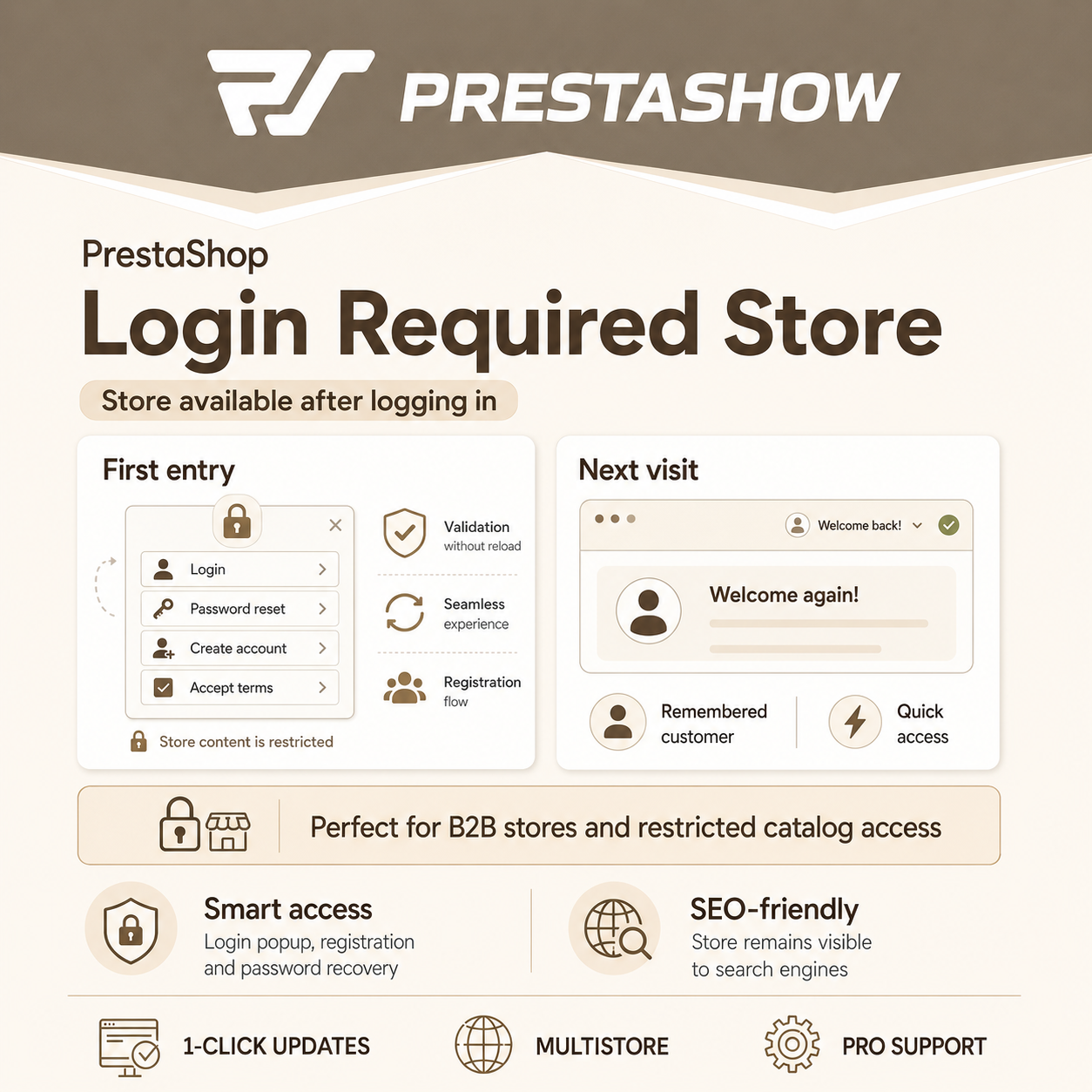
One of the first decisions when implementing B2B sales concerns whether the catalog and prices should be publicly visible or restricted to logged-in accounts. Many wholesale businesses don't show prices to anonymous visitors as a rule — partly for competitive reasons (wholesale prices are rarely public), partly because sales are conducted exclusively with verified, established accounts rather than random visitors from the internet.
In practice, different models coexist: from a fully closed store (login required, zero anonymous traffic) to a hybrid model where general product information is public, but specific net prices only appear once a business account has been created. The right choice depends on whether the offering is also meant to serve a marketing function (search visibility, acquiring new customers) or purely an operational one (existing accounts placing recurring orders).
Sourcing — product data from multiple suppliers
This is one of the more underestimated yet time-consuming parts of running a B2B store. A company selling goods from several or a dozen suppliers has to continuously update prices, stock levels, descriptions and images — and any mismatch between the supplier's system and the store's own data leads directly to selling stock that's no longer physically available, or showing incorrect prices to customers.
Manually entering and updating product data simply stops scaling once volume grows (hundreds or thousands of items). Companies typically address this by automating data exchange with suppliers — whether through files (XML, CSV) or direct API access — along with careful category and attribute mapping, which tends to be the most common source of errors in such integrations.
Purchase terms suited to wholesale
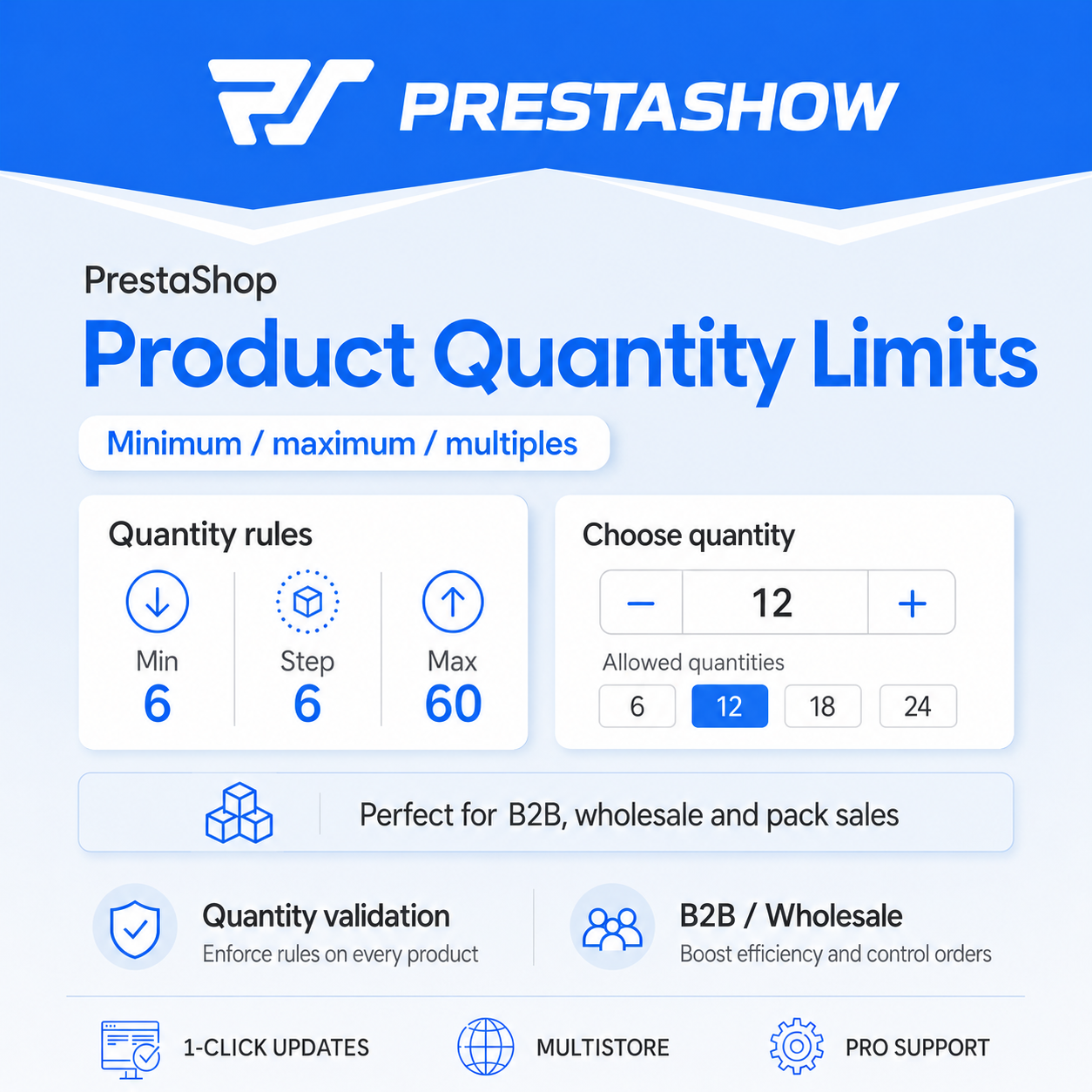
In retail, buying a single unit is the norm. In wholesale — less so. Goods are often packed in bulk units (boxes, pallets), and selling a single item can be logistically unprofitable or physically impossible. Conversely, some products (limited editions, promotions) require the opposite — a cap on the maximum quantity per order.
A store that doesn't reflect this logic allows situations where a customer tries to order a quantity inconsistent with the supplier's actual sales terms — which ends up being corrected after the order is placed, rather than validated automatically in the cart. For a business customer, that's added friction that essentially doesn't exist in B2C.
Pricing, volume discounts and repeat purchases
A classic B2B price list is often maintained manually, in a spreadsheet, with individual arrangements for each account. That works with a handful of clients, but stops scaling as the number of accounts grows — keeping such a price list up to date becomes an administrative burden in its own right.
A better-scaling alternative is basing discounts on rules — e.g. quantity thresholds (the more units in an order, the lower the unit price) and customer group membership — instead of negotiating and manually entering a separate price for every single account. Another common element is rewarding consistency of purchases rather than just one-off volume — which matters especially where a customer has a choice between several suppliers of the same goods.
Payment terms in business relationships
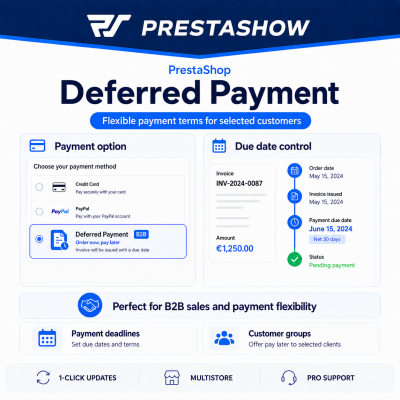
Paying upfront when placing an order is the norm in retail. In business relationships, deferred payment terms are more often the norm — typically 7, 14 or 30 days, depending on commercial arrangements and the history of cooperation with a given account. A store that requires prepayment from every business customer effectively turns away part of its potential buyers, for whom flexible payment terms are sometimes a condition of doing business at all.
Supporting deferred payment terms — including reminders as a due date approaches and tracking payment status per client — is often one of the more common reasons companies abandon ordering through an online store in favour of a traditional phone or email arrangement with a sales rep. Missing this doesn't disqualify a store, but it limits its usefulness for part of the business customer base.
Cross-border sales in the EU and VAT
B2B sales to customers in other EU countries come with distinct VAT rules. As a general principle, a supply of goods to a VAT payer registered in another EU country, subject to certain conditions (among them, actual transport of the goods between EU countries and the buyer holding a valid, active EU VAT number), may be settled at a 0% rate as an intra-Community supply of goods.
A practical requirement is verifying the buyer's EU VAT number in the EU's VIES system — without it, the seller risks tax exposure if the number turns out to be outdated or incorrect. The precise qualification of any specific transaction depends on multiple factors and is worth checking with an accountant or tax advisor on a case-by-case basis — this article describes the general mechanism, not tax advice for a specific situation.
Purchase documentation on the buyer's side
A purchasing department on the customer's side rarely accepts an order placed purely "on the fly," without a document for internal archiving or further approval. A quote or order document that can be sent to a manager for sign-off, or attached to internal workflow, tends to be expected almost automatically by people responsible for procurement.
A store that doesn't provide this forces the customer to prepare such documentation manually, from screenshots or a hand-typed summary — inconvenient, and more error-prone. It's a detail that's easy to overlook when designing a B2C store, yet for a business customer it's often one of the first questions before agreeing to work together.
Summary — when it makes sense
PrestaShop works best for B2B sales when a company:
- sells to both business and individual customers and wants to run both within a single system,
- is looking for a lower implementation and maintenance cost than systems built from scratch for large, complex B2B structures,
- has relatively clearly defined, repeatable sales processes that can be addressed with specific technical solutions,
- wants to keep full control over data, hosting and integrations, rather than committing to a closed SaaS platform.
It's not worth assuming that installing PrestaShop alone gives you a ready-made B2B store — it doesn't. But with a deliberately planned implementation covering the areas described above — access to the offer, supplier sourcing, purchase terms, pricing and discounts, payments, cross-border settlements and documentation — it's possible to build a business store that genuinely improves the purchasing process, rather than being just a retail store with an added VAT invoice.